AI at the Front Desk: How Intelligent Workflows Are Transforming Healthcare Administration
In this episode of Health Innovation Matters, host Michael Levin-Epstein sits down with Jay Volk, CEO of Weave Cloud Solutions, to explore how modern technology—especially AI-driven tools like Intelligent Document Processing (IDP)—is reshaping the way healthcare administrative work gets done. Gone are the days when clinicians and back-office staff were buried in paperwork and repetitive tasks. Instead, innovative platforms are automating essential processes, reducing workload, and enabling care teams to focus more on patients rather than paperwork. Jay and Michael unpack how these technologies work, why they matter for efficiency and patient outcomes, and what healthcare professionals should know as AI tools become part of everyday workflows.
Key Points
- The administrative burden in healthcare — A longstanding challenge that saps clinical time and contributes to inefficiency.
Introducing Intelligent Document Processing (IDP) — What it is and how AI can automate the extraction and handling of unstructured and structured data.
Real-world impact — How streamlined workflows free up staff time and improve patient experience and outcomes.
AI’s role across the organization — From front-desk tasks to clinician support, the rise of AI reshapes roles and expectations in healthcare.
Preparing for change — What healthcare leaders should consider as they adopt AI-powered workflow tools (e.g., training, adoption, measuring impact).
Jay's Podcast Transcript
Jay Volk:
It is heartbreaking when people have to just sit and look at a screen and index a document, instead of making that patient feel welcome and, and helping them with their care, helping them with their childcare, whatever it is, uh, WEAVE is really trying to, uh, take their eyes off that screen and help ’em put their eyes on the patient.
Michael Levin-Epstein:
Hello and welcome to episode 100 of Health Innovation Matters, one of the fastest growing international podcasts on cutting edge issues and solutions in healthcare, diagnosis, treatment, administration, and policy. This is the podcast where you’ll find out what’s really happening in healthcare today and in the future. We cover disruptive technology and game changing issues, such as cancer prevention, population health insurance covers digital health, precision medicine, ai, blockchain, regenerative medicine, gene therapy, Alzheimer’s, and much more. I’m your host, Michael Levin Epstein, and I’m also the creator and producer of Health Innovation Matters. I’m so happy you decided to spend some of your valuable time with us today in search of cutting end solutions for the healthcare issues you deal with every day. And just a reminder, the only way to guarantee you won’t miss a single episode of Health Innovation Matters is to subscribe. That’s right. Subscribe, remember, it’s free and it’s on all your favorite podcast platforms.
So here’s a question you may have been asking yourself lately. What’s the impact of AI on patients? It’s a pretty good question, right? Well, we’ve got just the guest to help us answer this question and several others. So let’s meet him right now. Our guest, Jay, is Jay Bulk. Jay is Chief Executive Officer at Weave Cloud Solutions, which provides revolutionary technology and enhances productivity of healthcare teams, reduces revenue, uh, leakage and accelerates time to care for patients, and that leads to healthier, happier patients, providers, and staff. With more than two decades of experience in operations and business development in the healthcare industry, Jay brings a unique blend of business acumen credentials that, that really, uh, tell you about his incredible competencies, and he brings also compassion to his role. Jay’s core competencies, including healthcare strategy, partnerships, profitability, growth, and leadership. Welcome to Health Innovation Matters, Jay.
Jay Volk:
Thanks Michael. Thanks for having me on the, the podcast. I really like the companies and the people that you’re spotlighting on this program. Uh, Tom Liddell is a personal friend of mine and is doing great things in Harmony Healthcare, and Dr. First was a partner of mine back when I ran workflow com, so it’s a great time to be talking about healthcare technology, and it’s good to see that the people in companies that I’ve known for the last 20 years are really making a difference. So thank you for highlighting our story.
Michael Levin-Epstein:
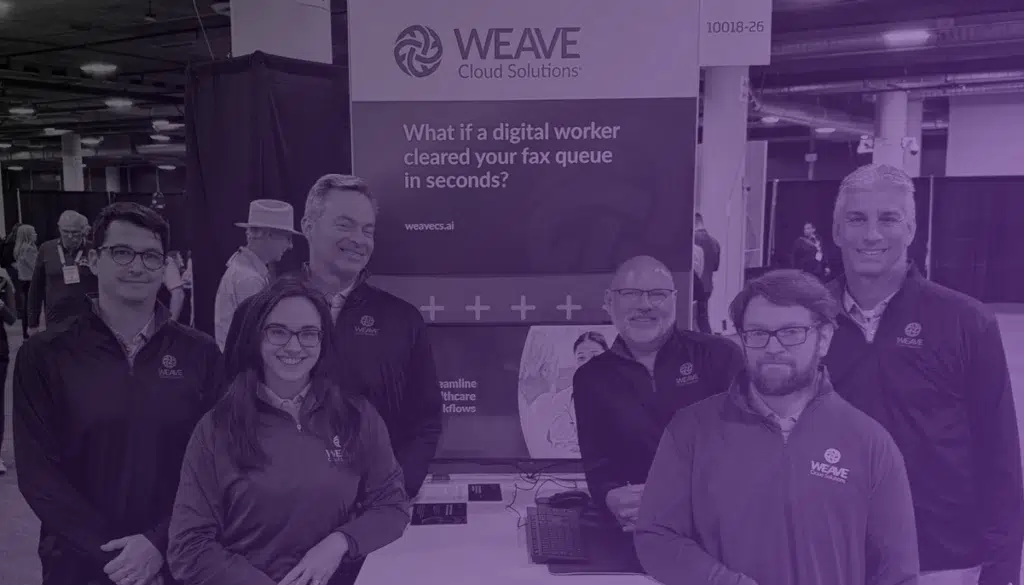
Well, we’re pleased to have you here. And you know, it’s a, it’s a funny thing, but some people think about the, the healthcare industry as being so incredibly large, which it is, but we, we have found, especially in the last, um, three months, that there’s probably just one degree of separation between a lot of these people and Yeah. Yeah, Tom was terrific and, and Doctor First was, was too, um, uh, that, you know, uh, when we talked about Dr. First just a little while ago, so let’s begin with with we’ve Cloud solutions. It’s a relatively new, um, startup that recently launched and, uh, made quite a splash at at HIMSS 25, and I know you were there. I was there. So how is w we, we’ve Cloud Solutions uniquely positioned to make an impact on the healthcare industry?
Jay Volk:
Yeah, thanks for that question. Uh, weave is a natural outgrowth of Eax. Eax has been around for 20 years as an infrastructure, as a Service Cloud fax company, and we like to think of eax as the mailman. So any document, a fax, mail, email, secure message, whatever is delivered from one point to the other by either fax. And in many cases, the document is delivered and sits in a share drive on somebody’s desktop, and there could be, uh, life or death information, uh, trapped in that fax document. We call it unstructured data because people don’t know what’s in it, people don’t even know if it’s there. And so if somebody’s on vacation or they’re sick or they’re attending a child’s event, um, action on that document is delayed. What Weave does, we are a, uh, intelligent document processing solution that powers healthcare, workflow and workflow.
Uh, as you mentioned in my, uh, biography, that, uh, is a company that I ran for 12 years, so I know my way around healthcare workflow. Uh, we think of Weave as the mail room. So if Eax is delivering the letter, weave is taking it, opening it up, looking at it, seeing who needs to act on that. Um, we take that unstructured data, we extract data from it, and we use AI to determine what it is, what it contains, and who needs to see it. We can also look for specific words like Stat or Urgent to bring it to the top of the funnel for, uh, people who are going through these documents. And our vision for Weave is that information will be communicated faster because of that referrals and medication refills will be filled faster and people will be healthier because of, of what we do. Everything we do at Weave is focused on better patient outcomes.
Michael Levin-Epstein:
So you’re not only playing in the health systems space, but also hospitals and community clinics and major medical groups. Your universal in terms of, in terms of being in the healthcare community?
Jay Volk:
Yeah, that’s right. We can go down to a single doc practice if we need to, and a lot of times, um, you know, the most valuable resource in a practice is the staff. And, uh, if the healthcare provider is having a hard time attracting staff or maintaining staff, staff, uh, weave is a product that they can put right in there that, uh, turns a lot of these documents around and keeps the practice running.
Michael Levin-Epstein:
So I, I think it would be helpful if you gave our listeners maybe an example of, of how Weave is is uniquely positioned to, you know, really, um, increase productivity and reduce, you know, error in, in terms of dealing with patients. You know, it’s a, just pick any area that you want and maybe give an example about how this kind of, you know, document being, being the kind of post office in the document situation can really help out.
Jay Volk:
Great. Um, you know, what we see in healthcare, this is really a reaction to, uh, what we’re seeing on the ground. And that is all the high burnout rates and staffing issues, especially post COVID, uh, where the nurses are quitting and, uh, you know, they’re, they’re just having a hard time with staff. And we talked to people today about, uh, declining reimbursement rates and how people have had their own, um, surgery centers that they’ve had in the town, and, you know, the different surgeons in town will collaborate on those. But now with declining reimbursement rates and difficulty of finding staff, those are just closing. And what we’re finding then is, um, that, that people are not able to maintain those businesses. And, uh, we is also helpful in revenue cycle. Um, as my friends who are doctors say that when the revenue dries up, the fire dies.
So, uh, I come from revenue cycles, still have a lot of friends who are in there and, uh, there’s things like prior authorization delays, workforce shortages, rising cost to collect, and cybersecurity. Those are the main issues they’re dealing with. So what we do specifically with that, uh, claims processing, we extract, validate, and submit a clean claim, uh, with prior auths. We go in and we extract the correct data so that that, uh, prior auth goes out and comes back faster so that patient gets care faster. Um, and I’ve already talked about workforce shortages, but in terms of, uh, cost to collect, it’s the claim submission, it’s going through clean, it’s not getting rejected by the payer, and it’s coming right back. And then Weave is a high trust certified, uh, system. So we operate on a secure delivery network, and we keep all those cyber threats away as well.
Michael Levin-Epstein:
So yeah, that’s, that’s really fascinating. Um, so let’s talk a little bit about the, you know, this major problem going on with nursing shortages. So, you know, if you go into a little bit more detail about how you deal with that, how, how, how this, you know, this, this document management system will help when so many places, I mean, especially obviously hospitals and healthcare systems are really finding it hard to be fully staffed up in terms of nursing.
Jay Volk:
Yeah, I mean, what we’re finding is that, um, these documents are coming in and they’re sitting somewhere, um, at, at, uh, a year ago at HIMSS I had a doctor walk up to me and say, Hey, we’ve got 300,000 unopened faxes. And you know, first thing as a, I’m a recovering lawyer, my first thought is, well, you got legal liability because that’s an issue. And a lot of these hospitals understand that. And since they can’t find, uh, people from the community that will come in and work the job, ’cause if they come in and do a good job indexing documents, they’ll walk down the street to Costco and make five an hour more. Um, instead they’re pulling nurses off the floor and they’re having them sit at the desk and index documents. And there’s nothing in Nurse Hates more than doing a job that’s not their job.
Nurses are extremely important to the proper functioning of the American healthcare system. And to, uh, have them sit at a desk and do a job that is, um, below their grade is just not doing a, not doing justice to anyone. Um, the main thing in American healthcare is that, uh, that staff is the one, they’re the ones who give people the feelings of coming into the practice and they’re welcomed and, uh, you know, they, they, they stay with that provider, they stay with that practice because they know the people, they’re in their community. And, um, it’s heartbreaking when people have to just sit and look at a screen and index a document instead of making that patient feel welcome and, and helping them with their care, helping them with their child care, whatever it is, uh, weave is really trying to, uh, take their eyes off that screen and help ’em put their eyes on the patient.
Michael Levin-Epstein:
Right. So let’s do one more question before the break, and what I’d like to ask you is a little bit more about, uh, you know, you gave a a bit about the history of, of, of, of Weave. When, when did you actually launch, where were you located, and you know, how large, uh, uh, a company are you?
Jay Volk:
So yeah, we’ve launched, um, at HIMSS. So we, uh, formed a company, um, officially in January. We, um, we started some development at the, uh, end of last year. Uh, we had the idea, and we’ve been on the ground, uh, for quite a while, but, uh, finally honed in on what part of this problem we wanted to tackle. Um, the office right now is, uh, in Ocala, Florida. So we are based down there. Um, we’ve got probably 10 employees, uh, that are working on this. Um, majority of those are software developers as, uh, you could imagine in a technology company. Um, we’ve got, um, not really any sales, uh, person. Uh, so as the CEOI get out there and I talk to people and, uh, we’re looking for, uh, additional pilot sites and people where we can sit down with them and learn. Uh, one of the things we want to be as a company is the company that listens to our clients. We feel like, uh, a lot of people want to just slot technology in and, uh, tell people if they can’t figure out how to make it work, they need to work harder. Uh, and we don’t believe that at all. We think that technology needs to be configured and work the way that practice needs to.
Michael Levin-Epstein:
So it must been very exciting for you to actually launch this at HIMSS. And, um, and what kind of reaction did you get from the people that you talked to and told them, look, we’ve got this great new company and we wanna tell you about it. What, what was their reaction?
Jay Volk:
Well, it was funny because, um, we were in the ETHERFAX booth. And ETHERFAX had a 20 by 50 booth and, uh, before the show I said, Hey, you know, there’s probably gonna be 90% fax talk and 10% weave, so 10% of people will want to hear about this. And by the second day, uh, Paul Banko, the CEO of ETHERFAX stopped everybody and said, okay, day one was 90% weave and 10% ETHERFAX <laugh>. So thanks for being here guys, because you’re the ones who are bringing the crowd in <laugh>.
Michael Levin-Epstein:
Wow. That, that, that’s really interesting. And that’s a, that’s a, a good note to, to now take a short break, a very short break, and we’ll be back soon, so don’t go anywhere. And we’re back, and we’re talking to Jay Vol of Weave Cloud Solutions, and I think, you know, what’s gonna come now, Jay, because you mentioned AI a few times, it’s pretty impossible to have a conversation in any industry, but especially in the healthcare industry without talking about ai. So how can AI in intelligent document processing address the issues that we’ve talked about in terms of improving patient, uh,
Jay Volk:
Outcomes? Yeah, um, great question. And, uh, what we’re really doing is reducing friction in the system. Um, there’s so much expense in American healthcare. I always joke that healthcare is the only sector where you introduce technology and stuff gets more expensive. Uh, everywhere else you add a computer, you add something, the service gets less expensive. Um, but an urgent order that’s seen and statused immediately is gonna be, uh, acted on faster. And I’ll give a real world example of this. Uh, we have clients that are one of five institutions that are receiving a request for a lab. So what they do is they use Weave to open it and get it to their calling center faster than their competition, make the phone call and schedule the lab before their competition has even opened up the facts. Um, and that’s better, more efficient practice to medicine, and that’s gonna lead to better patient outcomes.
Michael Levin-Epstein:
So let’s, let’s, um, play off of that in terms of patient outcomes. If you can, you know, it’s great that you give these, um, you know, real world examples and I, I want you to do that here. You know, talk about, I mean, I, I think everybody’s kind of familiar with how AI can help clinicians and, and help administrative staff, but I’m not sure they really understand how it can help patients. And so if you could hone in on that and maybe give maybe a couple of examples of really how it improves patient outcomes.
Jay Volk:
Yeah, and, and for us, the improving of patient outcomes, uh, goes to the, the, uh, facts not being dropped. So let’s take referrals for an example. Uh, you go into the doctor, the doctor says, Hey, you need to see a urologist. They send a message out to a urologist, Hey, go and give Michael a call. Have him come in. Um, you forget the doctor’s name. The doctor doesn’t open the fax. You go home, you’re feeling better. The doctor never makes the call. You never go in for the referral. Um, when you have a problem, again, it’s maybe 6, 8, 9, 10 months down the road. But now it’s a real problem. Now it’s something where, uh, our healthcare system is gonna have to spend a lot of money to get you healthier. When, if you would’ve, if that wouldn’t have been dropped, uh, six months ago, you could have gone in, had a routine visit with a urologist and everything would’ve been fine. Um, this, this is not a, uh, one time event. We figure about 46% of referrals are dropped. So about half the time people need to go in, need to see a specialist, uh, their lives would be better, they would be healthier. Uh, the cost to, uh, the American healthcare system would be less, less, um, and it, and it’s dropped just because that fax doesn’t get opened in time.
Michael Levin-Epstein:
Right. Uh, I think that’s a really, really good point. Um, so, uh, we have time for one more, uh, question, and it’s gonna be kind of an open-ended question. I, I want you, you know, to you to get into your crystal ball that I know that you have in your office and predict where we might be five years from now, um, in terms of new technology, AI and other new tech technology changing the healthcare, um, system in general. Um, and, and then the part, you know, if you want to add where Weave would be maybe five years from now.
Jay Volk:
Great. Um, I think that, uh, AI is gonna continue to improve. I think that, um, you know, what you’re seeing now is, uh, larger models where you can feed more and more data into ai and it’s making better, uh, decisions. And, you know, everyone looks back at the beginning of AI when it would kind of fall off a cliff at certain points. But, uh, now I think that, uh, AI is taking this information and, uh, putting it in a format that everyone can use, and I think it’s gonna be a great asset to doctors. I know that when I went in to see my, uh, primary care physician, he had, uh, his, um, his phone down to listen to the conversation. It was listening to everything I said, and it was incorporating those things into the note automatically. And, uh, since the beginning of EMRs, there’s been complaints about, um, technology not operating the same way that a doctor does.
A doctor sees a patient walk through the door of the office and they already see, um, you know, five or six different things they can observe that are medical. I think that AI is gonna start to move toward the front of those visits, and it’s gonna start to, uh, give us warnings and hints of when things in ourselves are breaking down. And I think that’s gonna be an early warning system that we’re all gonna benefit from and from weaves perspective, I think as we continue to operate in healthcare, uh, you know, we wanna be a true platform of interoperability so that we can take disparate data from different systems, dispar, uh, break down that data and put it into the system, uh, where it needs to go so that, um, that providers can act on it.
Michael Levin-Epstein:
Well, that was an absolutely great example of AI playing a role in the, the, as you say, the kind of front door of the healthcare system when a patient comes into an office. That, that was really, really terrific. So, um, just one more quick question, which is, where can people find you? Where can they find Weave? What’s your URL, what’s the best way of having them get in touch with you?
Jay Volk:
So if you wanna get in touch with me, I’m easy to find on LinkedIn. Um, and I have lots and lots of, uh, people I’m connected with through, through all of my different, uh, hats that I’ve worn. Uh, weave is on at Weave CS ai, so you can find our website there. But like I said, LinkedIn is a, is a good place to start if you wanna.
Michael Levin-Epstein:
Well, that’s great, and, and we will put your URL into our show notes so people can look for it there. And, and thank you so much, Jay, for being such an incredible guest today on Health Innovation Matters. I’d also like to thank our assistant producer, Sam Hoffmeister. Finally, thanks to all of you for tuning into Health Innovation matters. Remember, if you’d like to have, have a, uh, situation in which you’re a, a guest or a sponsor or a marketing partner, or you just have ideas about upcoming episodes or you wanna just chat with me, I am available by email at Michael dot levi [email protected], or you can just ping me on LinkedIn. And this is Michael Levi Epstein, and we will see you next time on Health Innovation Matters.