

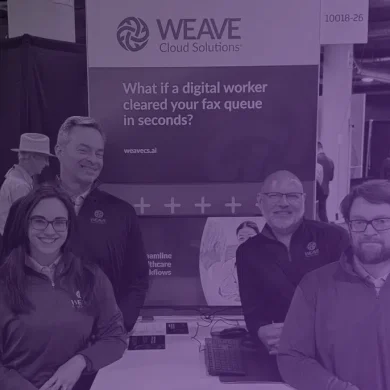
If you walked the HIMSS26 floor in Las Vegas, one theme was impossible to miss: Healthcare has moved past AI experimentation. The conversation is now about execution.
Across keynotes, panels, and hallway conversations, leaders weren’t asking if AI could help—they were asking: Where can AI deliver measurable operational impact today?
And the answer, repeatedly, wasn’t in futuristic clinical decision-making.
It was in something far more immediate and far more painful: Administrative document workflows.
The HIMSS 2026 reality check: from AI hype to ROI accountability
HIMSS26 made one thing clear: the market has shifted from curiosity to accountability.
Attendees and speakers consistently emphasized that healthcare organizations are now prioritizing:
- Measurable ROI over pilot programs
- Workflow execution over theoretical AI capabilities
- Operational efficiency over standalone innovation
According to Beckers Health IT, health systems are under increasing pressure to tie technology investments directly to cost reduction and performance outcomes.
Similarly, Healthcare Dive highlighted that agentic AI, i.e., autonomous workflow execution, gained traction primarily in administrative use cases, where risk is lower and ROI is easier to quantify.
This aligns directly with what attendees saw on the show floor: AI is no longer being evaluated on potential. It is being evaluated on productivity.
The bottleneck everyone acknowledged but few have solved
Despite years of digital transformation in healthcare, there are major constraints that have repeatedly surfaced as pain points across the industry:
- Referrals still arrive via fax
- Prior authorizations are still PDF-driven
- Clinical documents are still scanned and manually indexed
- Staff manually rekey data into the EHR
These problems are not niche issues. They represent the front door of healthcare operations, and these workflows remain overwhelmingly manual. Industry data reinforces the scale of the issue:
- Healthcare spends nearly 25% of total expenditures on administrative costs, much of it tied to manual workflows and documentation (JAMA)
- 93% of physicians report prior authorization delays patient care, highlighting how document-driven workflows directly impact outcomes (American Medical Association)
At HIMSS26, the disconnect was openly discussed: AI strategies assume structured, real-time data—but most organizations still receive critical information as unstructured documents.
That gap is where transformation is now happening.
Why agentic AI depends on intelligent document processing
One of the most discussed concepts at HIMSS26 was agentic AI—systems capable of executing multi-step workflows autonomously.
But there’s a critical dependency: Agentic AI cannot operate without structured, actionable inputs.
Before any system can:
- Schedule a patient
- Initiate a prior authorization
- Route a referral
- Trigger a billing workflow
…it must first interpret the data that came in.
And today, what comes in is still: Fax. PDF. Email. Scanned documents.
This is why GenAI-powered intelligent document processing (IDP) emerged as one of the most practical and immediate applications of AI at HIMSS.
The IDP solutions that deploy digital workers to augment and support overwhelmed staff were the companies seeing the most success on the floor of HIMSS. Digital workers remove the taxing physical human labor of processing paper-based documents, helping hospital and health care systems with staffing issues such as hiring, burnout, and retention. This is the future of healthcare.
From document handling to EHR-native workflow execution
Traditional document workflows are slow because they exist outside the systems where work happens.
- A referral arrives in a fax queue.
- An authorization sits in an inbox.
- A document is downloaded to a local file folder, renamed, uploaded, and manually entered into the EHR.
A GenAI-powered IDP pipeline changes that architecture entirely.
Instead of documents living in disconnected channels, IDP:
- Ingests documents at the point of entry (fax, email, upload)
- Extracts structured data using GenAI
- Identifies patient and encounter context
- Integrates directly with the EHR, inserting both documents and data into the correct workflows
Referrals populate referral queues. Authorizations update tracking fields. Clinical documents attach to the correct patient record. Billing attachments map to claims.
No manual indexing. No rekeying. No delays. This is not just about structured data—it is about activating workflows inside the EHR in real time.
The result:
- Reduced latency from intake to action
- Fewer errors and rework cycles
- Faster scheduling, authorization, and billing processes
This is where AI moves from automation to operational transformation.
Fax isn’t going away—but its friction is
Another reality reinforced at HIMSS26: Fax is not disappearing.
In fact, it remains deeply embedded in healthcare communication. Studies estimate that greater than 70% of healthcare communication still involves fax, contributing to delays, errors, and inefficiencies (Konica Minolta).
What’s changing is not the channel but how fax is handled. At HIMSS 2026, the emerging model was clear: Fax becomes an ingestion channel, not a workflow.
With IDP:
- Fax is digitized instantly
- Data is extracted and structured
- Information is routed automatically
- Workflows are triggered immediately
The fax inbox doesn’t disappear, but it disappears from human effort.
ROI is now the gatekeeper for AI adoption
Perhaps the most important shift at HIMSS26: ROI is no longer optional—it is the entry requirement.
Healthcare leaders are asking:
- How many staff hours does this save?
- How quickly does it impact throughput?
- How much revenue is accelerated or recovered?
Organizations are prioritizing “measurable outcomes, not pilots,” especially in administrative workflows where impact is immediate. Document workflows are uniquely positioned to meet this demand because they directly affect:
- Referral-to-admit timelines
- Authorization turnaround
- Revenue cycle velocity
- Staff productivity
This is why intake automation is emerging as one of the fastest paths to ROI in healthcare automation.
Interoperability—without waiting for perfection
As it has been in previous years, interoperability remained a core theme during HIMSS in 2026, but the conversation has matured. The industry is no longer waiting for perfect data exchange standards. Instead, organizations are asking: How do we operationalize interoperability today?
The answer increasingly lies in:
- Converting unstructured inputs into structured data
- Making that data usable immediately across systems
- Enabling workflows regardless of how data enters the organization
IDP and digital workers effectively become the bridge between legacy inputs and modern, interoperable systems.
What healthcare leaders should do next
HIMSS26 made it clear: Success with AI will come from targeting real workflows, not abstract capabilities. Leaders should start with a simple set of questions:
- Where are manual document workflows slowing operations?
- How long does it take for incoming documents to become usable data?
- How many staff hours are spent on intake, indexing, and routing?
- What percentage of workflows could be automated from end to end?
- How quickly could ROI be realized?
The answers will point directly to where GenAI-powered IDP can deliver immediate value.
AI starts at the front door
HIMSS26 clarified a fundamental truth: AI does not start with intelligence. It starts with intake.
The organizations that succeed with their AI strategies will not be the ones that adopt the most AI tools. They will be the ones that fix the workflows that feed them. The fax inbox isn’t going away tomorrow. But for the first time, thanks to intelligent document processing in the fax inbox, the manual burden associated with it is optional.
And that is where real transformation begins.